Main Points UK Muslims
-
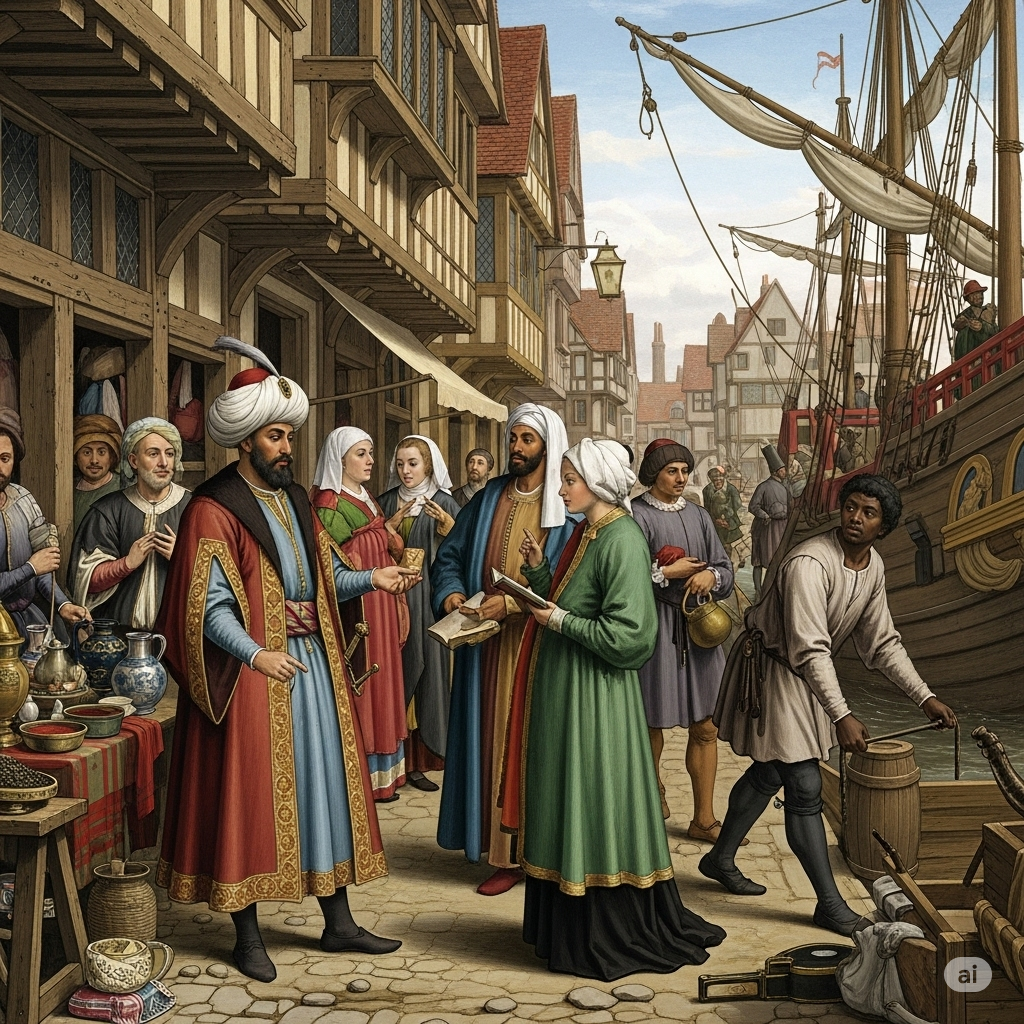
During the 16th century, Muslims were present in London, coming from North Africa, the Middle East, and Central Asia.
-
They worked in diverse capacities including diplomacy, trade, translation, and music.
-
Their presence reflected the early interactions between England and the wider Islamic world.
In the 16th century, London was already a hub of international trade and cultural exchange. Among the city’s residents were Muslims who had traveled from North Africa, the Middle East, and Central Asia. Their roles were varied, reflecting both the opportunities available in England and the skills they brought from their homelands.

Some Muslims served as diplomats, acting as intermediaries between their home regions and English authorities. Their language skills and knowledge of local and foreign politics made them valuable in negotiations and in fostering international relations.
Others worked as translators. With trade routes connecting England to distant regions, merchants and officials relied on translators to communicate effectively with foreign partners. This made the translators essential for trade agreements, contracts, and correspondence.
Many Muslims also became merchants themselves, trading goods that ranged from textiles and spices to crafted items. Their trade networks often spanned continents, linking London to markets across Europe, the Middle East, and Asia.
In addition, music was another area where Muslims contributed to London’s cultural life. Musicians from Islamic regions brought their instruments and performance traditions, introducing new sounds and styles to English audiences. This cultural exchange enriched the arts in the city and helped foster curiosity about distant lands.
Overall, the Muslims living in London during this period were engaged in roles that required expertise, adaptability, and cultural knowledge. Their contributions extended beyond commerce and diplomacy, influencing cultural and intellectual life in subtle but meaningful ways.
1. What regions did the Muslims living in 16th-century London come from?
In the 16th century, London attracted Muslims from a variety of regions, primarily North Africa, the Middle East, and Central Asia. These travelers arrived in England through trade routes or diplomatic missions, often bringing specialized skills, knowledge, and cultural practices from their home regions. Their diverse origins meant that London became a hub where multiple Islamic traditions converged, creating a small but influential community.
2. Which skills made Muslims valuable as diplomats in England?
Muslims in London often served as diplomats because of their language abilities, understanding of foreign political systems, and knowledge of international trade. They could communicate effectively with English officials while also representing the interests of their homelands. Their diplomatic skills were critical for negotiating agreements, resolving disputes, and maintaining relationships between England and other regions of the Islamic world.
3. How did Muslim translators support trade and communication in London?
Translators played a vital role in connecting English merchants with international partners. Muslim translators could read and write multiple languages, including Arabic, Persian, and Turkish, enabling them to translate contracts, trade documents, and letters. By bridging language gaps, they ensured smoother trade operations and helped prevent misunderstandings, which strengthened London’s position as a growing commercial center.
4. In what ways did Muslim merchants connect London to international markets?
Muslim merchants in 16th-century London were key players in global trade networks. They imported goods such as textiles, spices, and luxury items while exporting English products to their home regions. Their extensive knowledge of international markets allowed them to establish trust with buyers and sellers across continents. This connectivity contributed to London’s economic growth and enhanced cultural exchanges between England and distant regions.
5. What cultural contributions did Muslim musicians make to 16th-century London?
Beyond trade and diplomacy, Muslims also enriched London’s cultural landscape. Musicians from Islamic regions introduced new instruments, musical styles, and performance traditions. These contributions influenced local music, offering English audiences a glimpse into foreign cultures and fostering an appreciation for international art forms. Through music, Muslims helped create a cultural dialogue that complemented their economic and diplomatic roles.