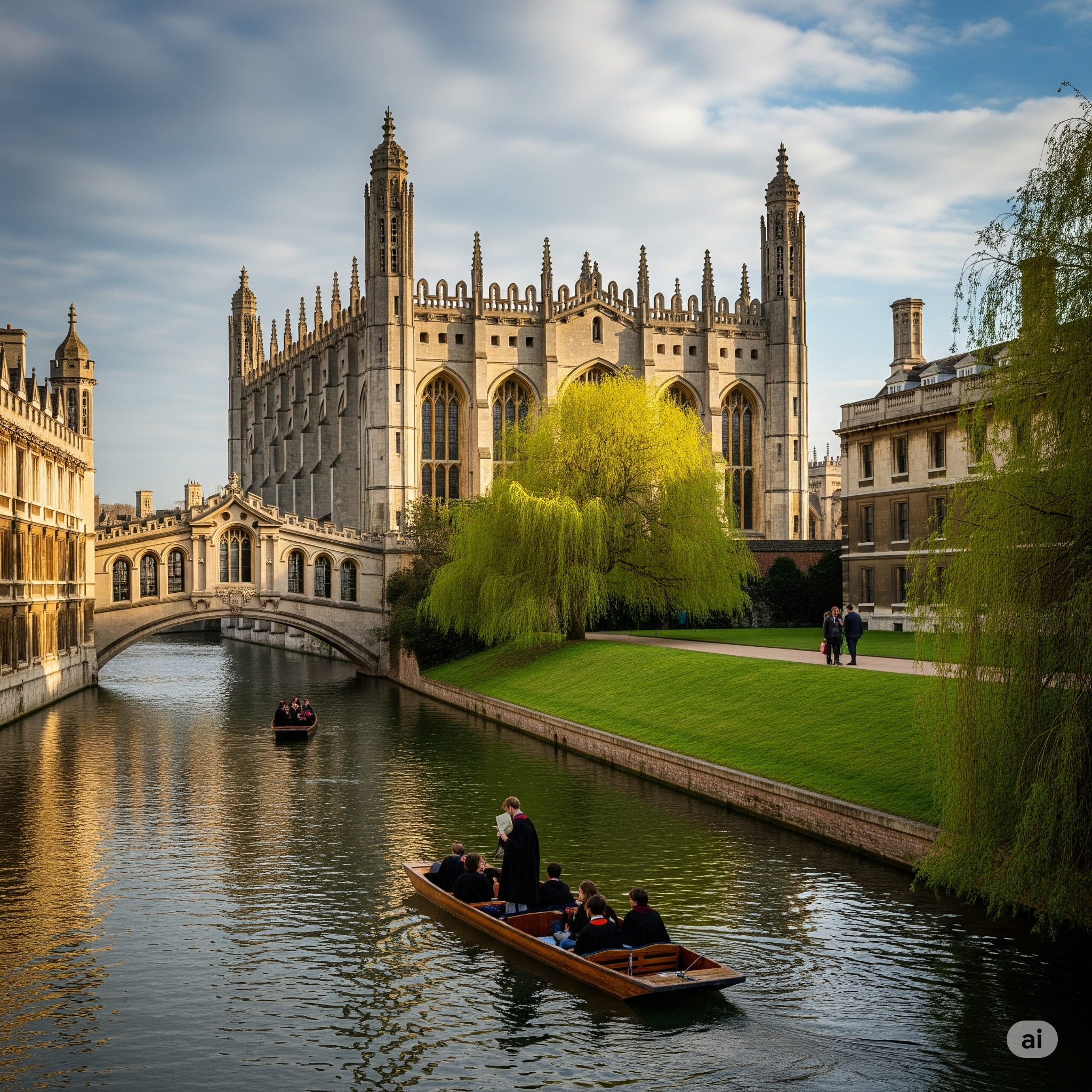
The University of Cambridge, based in the historic city of Cambridge, England, is widely regarded as one of the most prestigious universities in the world. Established in 1209, it has more than 800 years of academic tradition and has consistently been a leader in education, research, and innovation. With its unique combination of historic roots and modern advancements, Cambridge remains a destination for students and researchers from across the globe.
Cambridge is known for its remarkable scholars, influential alumni, and rigorous academic culture. It combines a traditional college system with cutting-edge research facilities, making it a unique academic environment that produces leaders in science, technology, medicine, arts, and humanities.

Main Points of the University of Cambridge – Cambridge
-
Founded in 1209, making it over 800 years old.
-
Recognized as one of the top universities worldwide.
-
Produced Nobel Prize winners, global leaders, and renowned researchers.
-
Operates under a college-based system offering personalized learning and community support.
-
Known for breakthroughs in physics, mathematics, medicine, and biotechnology.
-
Hosts world-class institutions such as the Cavendish Laboratory and Cambridge Judge Business School.
-
Students represent more than 140 nationalities, making it a truly international university.
-
Strong partnerships with industries and research organizations worldwide.
-
The University of Cambridge is located in Cambridge, England.
-
It was founded in 1209, making it over 800 years old.
-
It is recognized as one of the top universities worldwide.
-
Cambridge has produced more than 120 Nobel Prize winners, global leaders, and world-renowned researchers.
-
Famous alumni include Isaac Newton, Stephen Hawking, and Charles Darwin.
-
It consistently ranks among the top 3 universities globally along with Oxford.
-
The university operates under a college-based system that offers personalized learning and community support.
-
It combines historic traditions with modern advancements in academics and research.
-
Cambridge offers a rigorous curriculum in sciences, technology, medicine, arts, and humanities.
-
It maintains strong global partnerships with industries and research organizations.
-
The Cavendish Laboratory at Cambridge is famous for pioneering discoveries in physics.
-
The Cambridge Judge Business School is a global leader in business and management education.
-
The university has contributed major advancements in physics, mathematics, medicine, and biotechnology.
-
Students come from more than 140 countries, making it highly international.
-
Its international student ratio is over 40 percent.
-
Cambridge plays a vital role in shaping global education, research, and innovation.
-
Compared with Oxford, Cambridge was founded in 1209 and Oxford in 1096.
-
Both Cambridge and Oxford use college-based teaching systems.
-
Cambridge is stronger in sciences, technology, and medicine, while Oxford is stronger in humanities, politics, and philosophy.
-
Cambridge has more than 120 Nobel Prize winners, whereas Oxford has more than 70.
-
The University of Cambridge is considered a global center of ideas, leadership, and progress.
-
It contributes directly to advancements in science, technology, medicine, and society worldwide.
-
The unique college system fosters academic excellence, creativity, and leadership in students.
Cambridge in Detail
The University’s global reputation is strengthened by its ability to combine academic rigor with opportunities for discovery and innovation. The Cavendish Laboratory has been central to groundbreaking discoveries in physics, while Cambridge Judge Business School has built a reputation for advancing business and management education. Its strong international student presence further enhances its role as a global hub of learning.
Importance of the University of Cambridge – Cambridge
The University of Cambridge plays a vital role in shaping global education, research, and innovation. Its impact is not limited to the United Kingdom but extends worldwide through groundbreaking discoveries, advanced technologies, and influential graduates who lead in politics, business, science, and culture. Cambridge has been at the forefront of key developments, from pioneering theories in physics and mathematics to advancements in medicine and biotechnology.
The unique college system fosters both academic excellence and personal growth, making students feel part of a close community while accessing world-class resources. Its contribution to knowledge and society makes Cambridge more than just a university—it is a global center of ideas, leadership, and progress. For students, researchers, and innovators, the University of Cambridge is not only a place to study but also a place to shape the future.
Key Highlights of the University of Cambridge
-
Established in 1209, making it over 800 years old.
-
Ranked consistently among the top universities worldwide.
-
Known for producing Nobel Prize winners, world leaders, and leading researchers.
-
Offers a college-based system, providing personalized academic and social support.
-
Excels in diverse fields such as science, technology, medicine, arts, and humanities.
-
Strong connections with global industries and research institutions.

Cambridge in Focus
The University is recognized for its rigorous curriculum and intensive research environment. Cambridge is also home to globally known facilities like the Cavendish Laboratory, which has pioneered discoveries in physics, and the Cambridge Judge Business School, a leader in global business education. Students from more than 140 countries choose Cambridge, making it an international hub of knowledge.
Comparison: University of Cambridge vs University of Oxford
| Feature | University of Cambridge – Cambridge | University of Oxford – Oxford |
|---|---|---|
| Year Founded | 1209 | 1096 |
| Location | Cambridge, England | Oxford, England |
| Teaching System | College-based | College-based |
| Global Ranking (QS 2025 approx.) | Among top 3 worldwide | Among top 3 worldwide |
| Nobel Prize Winners | Over 120 | Over 70 |
| Famous Alumni | Isaac Newton, Stephen Hawking, Charles Darwin | J.R.R. Tolkien, Margaret Thatcher, Tim Berners-Lee |
| Research Strength | Sciences, Technology, Medicine | Humanities, Politics, Philosophy |
| International Student Ratio | 40%+ | 38%+ |
The University of Cambridge is far more than a center of learning; it is a driving force in global progress. It has shaped modern education, pioneered new fields of science, and contributed directly to advancements that benefit societies worldwide. Its influence stretches beyond the United Kingdom, with alumni who have become world leaders, influential thinkers, and innovators across disciplines.
University of Cambridge system works
The unique college system builds a sense of belonging while maintaining high academic standards, ensuring students thrive both personally and academically. By nurturing intellectual curiosity, creativity, and leadership, Cambridge continues to set benchmarks for universities around the world. Its importance lies not only in its history but in its ongoing contributions to knowledge, research, and global development.
The University of Cambridge, located in the historic city of Cambridge, England, is one of the oldest and most respected universities in the world. Founded in 1209, it has shaped global education for centuries and continues to lead in teaching, research, and innovation. Cambridge is home to outstanding scholars, influential alumni, and a community that blends tradition with modern academic advancement.