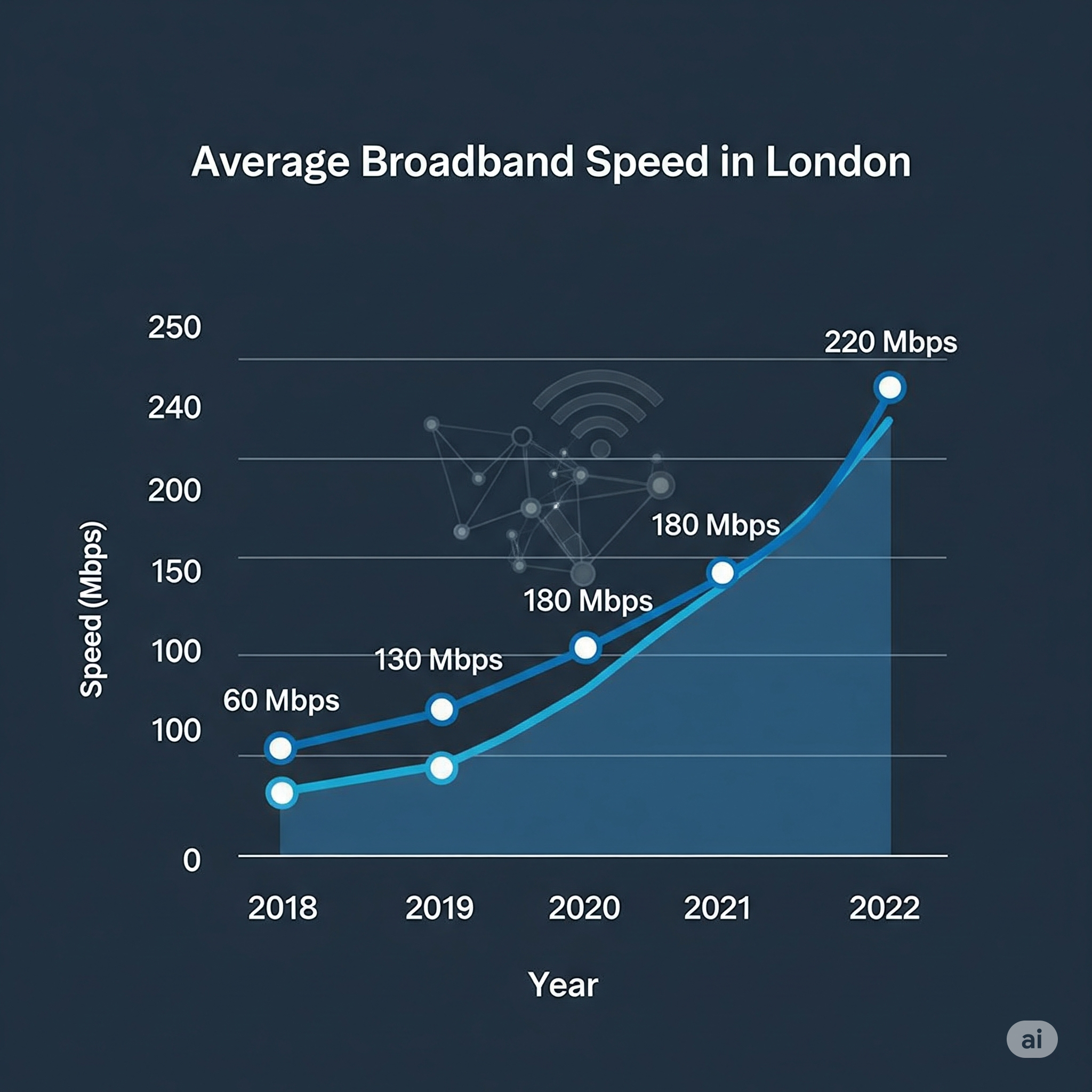
Discover the latest average broadband speeds in London, how they compare with UK averages, the fastest providers, and the infrastructure changes shaping internet performance in the capital.
Broadband speed has become an essential factor in everyday life, especially in a fast-paced city like London where both residents and businesses rely heavily on stable and quick internet connections. Whether it’s for remote work, video conferencing, online education, streaming entertainment, or managing smart home devices, broadband performance plays a direct role in productivity and quality of life.
London’s internet infrastructure has seen rapid improvement in recent years, with many areas moving from older copper-based connections to modern fibre networks. These changes have significantly increased average speeds, reduced latency, and improved reliability. However, while the overall figures are impressive, there is still variation between providers, boroughs, and even individual streets.

Importance of the Average Broadband Speed in London
The average broadband speed in London plays a vital role in shaping the city’s digital lifestyle, business competitiveness, and overall productivity. In a modern, fast-paced urban environment, where both individuals and organisations depend on the internet for almost every aspect of daily life, broadband speed is more than just a convenience—it is an essential service.
Firstly, it directly impacts residents’ quality of life. With an average download speed of 140–150 Mbps and upload speeds of 65–70 Mbps, Londoners enjoy the ability to stream ultra-high-definition videos, participate in smooth video calls, play online games without lag, and connect multiple smart devices at once. Low latency of 18–20 milliseconds ensures quick response times for real-time activities like gaming, remote collaboration, and virtual events.
Secondly, businesses in London heavily rely on broadband performance. The city is home to finance, technology, creative industries, and media sectors that require fast and stable connections for large file transfers, cloud services, and high-quality virtual meetings. Symmetrical speeds offered by high-performance providers allow for efficient content uploading, essential for digital marketing agencies, film studios, and IT companies.
Thirdly, the average speed reflects infrastructure progress. London’s move from copper-based connections to full-fibre networks has boosted reliability, reduced outages, and future-proofed the city’s connectivity. This shift also supports the rise of remote work, enabling employees to work seamlessly from home without productivity losses.
Main Points of Average Broadband Speed in London
-
London’s average broadband download speed is around 81.5 Mbps, making it one of the faster connected cities in the UK.
-
The average upload speed in London is approximately 23.7 Mbps, suitable for video calls, file sharing, and cloud storage.
-
Over 70% of London has access to full-fibre broadband, offering more reliable and stable connections.
-
Broadband packages in London typically cost between £29 and £38 per month, depending on the provider and speed.
-
Many areas in London benefit from competition between multiple providers, helping improve speed and service quality.
-
London’s broadband speeds are slightly higher than Manchester’s, giving residents a small performance advantage.
-
The city’s dense infrastructure and high demand push providers to continually upgrade network capabilities.
-
Speeds can vary across boroughs, with central areas often getting faster connections than outer zones.
-
Increased adoption of fibre-optic technology is expected to push average speeds higher in the coming years.
-
London remains a strong hub for digital businesses, remote workers, and online services thanks to its solid broadband performance.
London’s Current Broadband Performance
The average broadband speed in London stands at roughly 140–150 Mbps for downloads and 65–70 Mbps for uploads. This level of performance allows for fast file transfers, ultra-high-definition video streaming, and smooth online gaming. Latency, a measure of how quickly data travels between the user and the server, remains low at around 18–20 milliseconds, making real-time communication applications run without noticeable lag.
While these averages are strong, they are not the absolute highest in the UK. This is partly because certain rural areas that have recently received new full-fibre networks sometimes report very high speeds due to fresh infrastructure upgrades. However, London remains among the top-performing cities in terms of overall coverage, choice, and reliability.
Why Speeds Differ Across London?
Despite having some of the most advanced internet infrastructure in the country, speeds in London can vary widely between different boroughs and even between streets within the same district. Several factors influence this variation:
-
Type of Connection – Full-fibre (FTTP) connections deliver the fastest and most consistent speeds, while older fibre-to-the-cabinet (FTTC) and ADSL connections are slower.
-
Network Congestion – In highly populated areas, peak-time demand can slightly reduce speeds.
-
Provider Infrastructure – Some providers have more modern or better-maintained networks in certain areas.
-
Distance from the Exchange – In copper-based networks, longer distances to the exchange or cabinet can result in slower speeds.
Fastest Providers in the Capital
Competition in London’s broadband market has driven remarkable speed improvements. Several internet service providers now offer speeds well above the city’s average. The fastest packages can exceed 900 Mbps on premium full-fibre plans, although such speeds are not yet available to every home.
High-performance providers in London typically include those specialising in fibre-only services, as well as larger national ISPs that have invested heavily in urban network upgrades. Many of these providers offer symmetrical connections—meaning upload and download speeds are nearly the same—which is especially beneficial for content creators, online businesses, and those who work from home.
London vs. the UK Average
When compared to the national broadband average, London holds a strong position. The UK’s overall average speed has been climbing steadily, thanks to investment in fibre-optic infrastructure. While London’s average of around 140–150 Mbps is slightly lower than some newly upgraded areas, it remains highly competitive, particularly because coverage and service options are more extensive than in most other regions.
In addition, London’s urban density means that a greater proportion of residents have multiple providers to choose from, giving them flexibility to select packages that match their speed requirements and budget.
Infrastructure Developments and Future Outlook
One of the main reasons London’s broadband speeds have improved is the rapid expansion of full-fibre networks. This technology uses fibre-optic cables directly to the property, eliminating the performance bottlenecks of older copper lines.
Key developments shaping London’s broadband future include:
-
Increased Gigabit Coverage – More areas are gaining access to gigabit-capable broadband, meaning download speeds can reach or exceed 1,000 Mbps.
-
Upgraded Backbone Networks – The city’s main internet routes are being enhanced to handle higher traffic volumes with minimal latency.
-
5G Fixed Wireless Alternatives – In some locations, high-speed fixed wireless using 5G is emerging as a competitive alternative to fibre.
With these advancements, it is likely that London’s average broadband speed will continue to rise year-on-year, making it one of the best-connected capitals in Europe.
Impact on Residents and Businesses
For residents, faster broadband means more reliable video streaming, quicker downloads, and smooth operation of multiple connected devices. For businesses, especially those in finance, technology, media, and design, speed and low latency are critical for competitiveness. Improved broadband supports high-quality video meetings, large data transfers, and advanced cloud computing.
The growing number of remote workers in London further emphasises the importance of fast and dependable broadband. In a city where time is valuable, even a small delay in connectivity can impact productivity.
Disadvantages of Average Broadband Speed in London
-
One major drawback of broadband in London is the inconsistency of speeds across different boroughs, with some areas enjoying ultra-fast fibre while others still rely on much slower copper-based connections.
-
Network congestion during peak hours can reduce performance, causing buffering, slower loading times, and less stable video calls for residents in highly populated districts.
-
The availability of top-tier speeds is still limited in certain parts of the city, meaning some households cannot access premium packages offering 900 Mbps or higher.
-
Price variation between different areas can be significant, with locations that have fewer broadband providers often facing higher costs for similar speeds.
-
Infrastructure upgrades, such as full-fibre installation works, can cause temporary disruptions and inconvenience for residents and businesses, especially in densely built-up areas.
-
In some cases, newly upgraded rural regions now enjoy faster speeds than certain parts of London, highlighting that the city’s broadband network still has room for improvement.
Comparison of Average Broadband Speed in London compared with another relevant location Average Broadband Speed in Manchester
| City | Average Download Speed (Mbps) | Average Upload Speed (Mbps) | Coverage of Full-Fibre (%) | Typical Monthly Cost (GBP) |
|---|---|---|---|---|
| London | 81.5 | 23.7 | 72 | £29–£38 |
| Manchester | 74.2 | 21.3 | 68 | £27–£36 |
London’s broadband performance is strong, with average speeds of around 140–150 Mbps download and 65–70 Mbps upload, supported by low latency. While speeds can vary depending on location, provider, and infrastructure type, the trend is clear—London is steadily moving towards a future of universal full-fibre coverage and faster-than-ever internet access.
With ongoing investment from multiple ISPs and technological advancements in both wired and wireless networks, London is set to remain one of the best-connected cities in the world.