Introduction:
British Summer Time (BST) is the UK’s system of moving clocks one hour ahead of Greenwich Mean Time (GMT) during warmer months. The main goal is to extend daylight in the evening, encouraging energy saving, safer travel, and more time outdoors. While it may appear simple, the practice has had a significant effect on Britain’s economy, lifestyle, and daily routines for more than a century.
The Origin of Daylight Saving Ideas
The concept of adjusting clocks to match daylight is older than many think. In 1784, Benjamin Franklin suggested rising earlier to save candlelight. In Britain, William Willett, a builder and keen horse rider, campaigned strongly for it in 1907, arguing that society wasted valuable hours of daylight in the mornings. His proposal gained support in Parliament, although he passed away before it became law.
The First Adoption in 1916
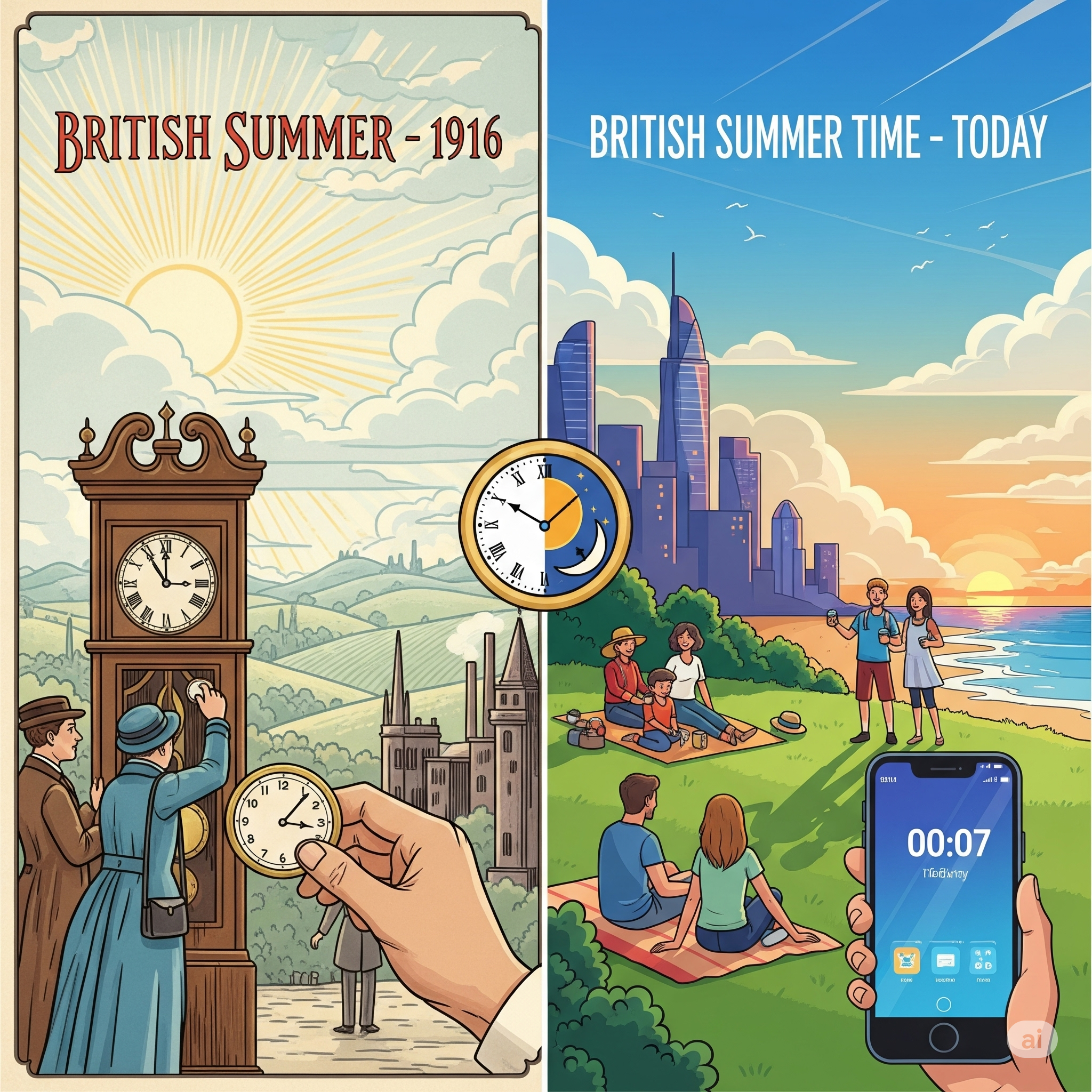
The First World War pushed Britain to adopt British Summer Time on 21 May 1916. Germany had already introduced a similar system to save coal, and Britain quickly followed. The measure reduced fuel use, gave factories longer daylight, and even improved agricultural productivity. This wartime success made BST a permanent seasonal adjustment.
British Summer Time During the World Wars
During the Second World War, BST was expanded into “Double Summer Time,” where clocks were set two hours ahead of GMT. This unusual step had several advantages:
-
Longer daylight helped with food production and farming.
-
Factories could maximize output with extended working hours.
-
Blackout rules became easier to manage with better use of natural light.
When the war ended, Britain reverted to the regular one-hour shift, but Double Summer Time remains an important chapter in its history.

Why was British Summer Time first introduced?
British Summer Time was introduced in 1916 during World War I to save fuel and make better use of daylight. By moving clocks forward, people used less artificial light and resources. It became a practical way to improve productivity during wartime.
How does British Summer Time affect daily life in the UK?
BST gives longer daylight in the evenings, which helps outdoor activities, retail businesses, and tourism. However, the clock change can disturb sleep patterns and create darker mornings, especially in northern parts of the country.
What is the difference between British Summer Time and Greenwich Mean Time?
Greenwich Mean Time (GMT) is the UK’s standard time in winter, while British Summer Time (BST) is one hour ahead of GMT and used from late March to late October. This shift ensures evenings are lighter for a longer period.
Did Britain ever try permanent British Summer Time?
Yes, between 1968 and 1971 Britain experimented with permanent BST, known as “British Standard Time.” Although evenings were brighter, mornings were darker, and the trial ended after public opposition, especially from northern regions.
Is British Summer Time the same as Daylight Saving Time?
BST is the UK’s version of Daylight Saving Time. While the idea is the same—moving clocks forward to use daylight better—other countries use different names and schedules. For example, the United States simply calls it Daylight Saving Time.
Does British Summer Time really save energy?
Originally, BST was created to save fuel and electricity, and it worked during wartime. Today, energy savings are less clear because modern technology and round-the-clock lifestyles reduce its impact, though lighter evenings still cut lighting use.
What would happen if British Summer Time was made permanent?
If BST became permanent, the UK would enjoy lighter evenings all year, which could benefit tourism, retail, and outdoor activities. However, it would also mean darker mornings in winter, raising concerns about road safety and school children.
Which countries do not follow British Summer Time or Daylight Saving?
Many countries near the equator and in Asia, such as Japan and India, do not observe seasonal clock changes. They get roughly equal daylight year-round, so systems like BST are less useful compared to regions further from the equator.
Why do some people want to abolish British Summer Time?
Critics argue that changing the clocks disrupts sleep, harms health, and complicates schedules. With energy savings less significant today, many believe BST is outdated and that the UK should either keep one time year-round or scrap the system.
What is “Double Summer Time” and why was it used?
“Double Summer Time” was when clocks were moved two hours ahead of GMT, used during World War II. It gave even more daylight in the evenings to help farming, factories, and national productivity, especially during long summer days.
Post-War Adjustments and Public Opinion
After 1945, the British government continued adjusting BST to suit national needs. However, public opinion remained mixed. Many city workers enjoyed lighter evenings, but farmers and parents in northern regions complained about dark mornings. These regional differences meant no single arrangement pleased everyone, keeping BST at the center of debate.

The Experiment of the 1968–1971 “British Standard Time”
Between 1968 and 1971, the UK tested a new approach known as “British Standard Time.” For three years, clocks stayed one hour ahead of GMT all year round. The change was intended to:
-
Give brighter evenings throughout winter.
-
Improve road safety during evening commutes.
-
Create a standard alignment with European trading partners.
Although evenings were lighter, darker mornings in Scotland and northern England caused major complaints, especially for school children. Parliament eventually ended the trial.
The Role of the European Union in BST Regulation
When the UK was part of the European Union, EU rules helped standardize when BST began and ended across member states. This ensured consistency for trade, travel, and communication. Even after Brexit, Britain has chosen to keep the March–October system. However, ongoing EU debates about abolishing seasonal clock changes have influenced discussions within the UK as well.
Seasonal Changes and Ongoing Debates
BST begins in the last week of March and ends in the final week of October. Every year, the change sparks fresh debate.
-
Supporters say lighter evenings improve health, outdoor activity, and tourism.
-
Critics argue that clock changes disrupt sleep patterns, harm productivity, and bring safety risks in darker mornings.
This back-and-forth keeps BST one of the most discussed time policies in modern Britain.
Calls for Permanent BST or Double Summer Time
Some campaigners believe Britain should adopt permanent BST, keeping evenings lighter all year. Others propose returning to “Double Summer Time” in summer months to maximize daylight even further. Supporters of these ideas often highlight benefits such as reduced traffic accidents, stronger retail sales, and healthier outdoor lifestyles. Still, opponents raise concerns about northern regions facing long, dark winter mornings.
Modern Perspectives: Safety, Economy, and Lifestyle
Research into BST’s impact shows both advantages and drawbacks.
-
Safety: Longer daylight in the evenings reduces road accidents.
-
Economy: Retail, hospitality, and tourism benefit from extra evening activity.
-
Lifestyle: Families enjoy more opportunities for sports, travel, and social events.
Yet sudden time changes can disturb sleep cycles, increase stress, and even affect workplace productivity. This balance explains why BST remains under review more than a century after its creation.
Comparisons with Daylight Saving in Other Countries
The UK is not alone in using seasonal clock changes.
-
Countries using DST: United States, Canada, and much of Europe.
-
Countries without DST: Japan, India, and most of Africa.
-
Former users: Russia and Turkey once used clock changes but now stick to permanent time.
These examples show that while some nations see DST as valuable, others consider it outdated for modern living.
Recent Discussions and Future of BST
Debates about BST’s future continue in the UK Parliament and in public opinion surveys. Some believe permanent summer hours would improve national health and the economy, while others think the practice should be scrapped entirely. With energy savings less important today and research highlighting health risks, the future of BST is still undecided.
Conclusion: The Continuing Debate Over Time
British Summer Time has been part of British life since 1916. It began as a wartime strategy but soon became a yearly tradition. Over the decades, it has been praised for its safety, health, and economic benefits, while also criticized for disrupting daily life. Whether Britain continues with BST, replaces it with permanent summer time, or ends it completely, the issue proves that the simple act of changing clocks can have lasting effects on society.