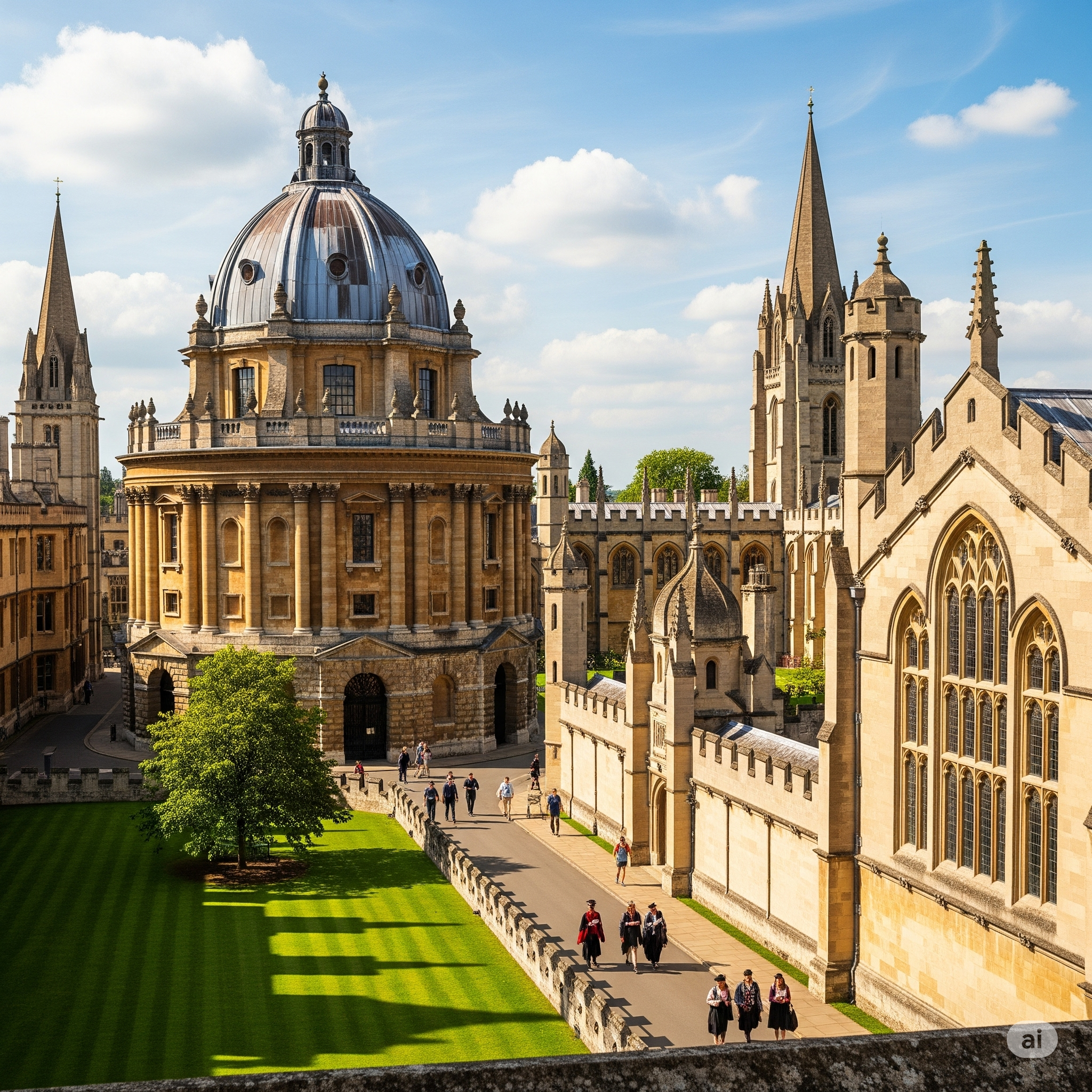
The University of Oxford, one of the oldest and most prestigious universities in the world, attracts students, academics, and researchers from every corner of the globe. Known for its rigorous academic standards, world-class faculty, and historic traditions, Oxford provides opportunities for undergraduates, graduates, visiting students, and international staff. If you are considering applying, this guide explains everything from admissions and scholarships to the unique collegiate system that sets Oxford apart.
Importance of the University of Oxford – Oxford
The University of Oxford stands as one of the oldest and most prestigious universities in the world. With its deep history, rich traditions, and reputation for academic excellence, Oxford attracts students, researchers, and scholars from across the globe. Its global recognition not only comes from its age and tradition but also from its commitment to world-class education, cutting-edge research, and a community that values knowledge, innovation, and intellectual curiosity.
One of the most important aspects of Oxford is its rigorous academic standards. The university is home to highly qualified faculty and offers a wide range of programs at both undergraduate and postgraduate levels. International students find Oxford especially appealing because of the clear guidance provided for admissions, scholarships, and visas. The competitive entry process ensures that only the most dedicated and capable students are admitted, making Oxford an institution synonymous with excellence.
Another key importance lies in Oxford’s unique collegiate system, which sets it apart from many other universities worldwide. Every student belongs both to a college and an academic department. While departments manage lectures, research, and examinations, colleges provide accommodation, libraries, tutorials, and personal support. This system builds strong academic and social communities where students receive personalized attention, especially through the hallmark tutorial method, which encourages critical thinking and deeper subject understanding.
Oxford also plays an important role as a hub for international opportunities. It welcomes visiting students, graduate researchers, and academics from around the world. Undergraduate students can study abroad at Oxford, while graduate researchers may apply for Recognised Student status. Moreover, international academics are invited to spend time at Oxford, benefiting from its libraries, research environment, and seminars. These opportunities strengthen global academic collaboration and make Oxford a truly international university.
Financial support is another area where Oxford shows its importance. The university offers a wide range of scholarships and funding options to outstanding students worldwide. These scholarships are tailored to different subjects, countries, and levels of study, ensuring that talented students, regardless of their financial background, can access a world-class education. This commitment to diversity and accessibility enhances Oxford’s role as a global leader in education.

Main points University of Oxford – Oxford:
-
The University of Oxford is one of the oldest and most prestigious universities in the world, known for academic excellence, top faculty, and historic traditions.
-
Application guidance is available for both undergraduate and graduate international students.
-
Undergraduate applications are submitted through UCAS with an early deadline of 15 October each year.
-
Graduate applicants may be required to provide research proposals, references, or written work depending on their chosen program.
-
Opportunities exist for visiting students, including undergraduates on study abroad, graduate research students under Recognised Student status, and academics visiting for one month to one year.
-
A wide range of scholarships and funding options are offered for international undergraduate and postgraduate students, varying by subject and country.
-
Oxford rarely signs institutional-level partnerships, but subject-specific collaborations can be pursued directly with departments.
-
International students must secure the correct UK student visa, with Oxford providing detailed visa and immigration guidance.
-
Students can apply to either Oxford or Cambridge, not both, in the same year.
-
Oxford emphasizes tutorials, Cambridge emphasizes supervisions, and both rely heavily on examinations for assessment.
-
Typical entry requirements are AAA–AAA at A-Level (38–40 IB points) for Oxford, and AAA (41–42 IB points) for Cambridge.
-
Oxford operates a collegiate system where students belong to both a college and an academic department.
-
Departments manage courses and exams, while colleges provide tutorials, libraries, accommodation, and academic support.
-
Applicants can choose a college or submit an open application, with offers sometimes coming from a different college.
-
Oxford’s tutorial system is its hallmark teaching method, involving one-on-one or small group discussions with expert tutors.
-
Applications are assessed holistically, considering grades, personal statements, admissions tests, written work, contextual data, and interview performance.
-
Applicants should choose a subject they are passionate about, read widely beyond the syllabus, and practice discussing their subject with different audiences.
-
Applicants should avoid exaggerating achievements, stressing over college choice, or being discouraged by competition.
-
Oxford remains one of the most competitive universities worldwide, combining rigorous academics, exceptional teaching, and a global community for students and researchers.
Key Highlights
-
Application guidance available for undergraduate and graduate international students.
-
Opportunities for visiting students, researchers, and recognized scholars.
-
Information on scholarships, fees, and funding.
-
Clear advice on student visas and immigration support.
-
Oxford generally does not partner with recruitment agencies but welcomes subject-specific academic collaborations.
-
Comparison with Cambridge regarding courses, application process, and interviews.
-
Insight into the collegiate system and teaching methods.
Applying to Oxford
The University of Oxford provides a detailed admissions process for prospective students. International undergraduates and graduates can access comprehensive information on requirements, qualifications, and application steps directly from the admissions webpages. Applicants are expected to demonstrate academic excellence, intellectual curiosity, and the ability to think independently.
Undergraduate Admissions
International undergraduates can apply to Oxford through UCAS by the early deadline of 15 October each year. Alongside predicted grades and references, some applicants will need to submit written work or take subject-specific tests. Successful candidates are usually invited to an interview in December, and final decisions are released by the end of January.
Graduate Admissions
Graduate students must apply for specific programs through Oxford’s graduate admissions system. In addition to academic qualifications, candidates may need to provide a research proposal, references, or written work, depending on the chosen course.
Visiting Students and Researchers
-
Undergraduate visiting students: Can apply for a study abroad period at Oxford through the visiting student scheme.
-
Graduate research students: May apply for Recognised Student status for research periods ranging from one to three terms.
-
Academic visitors: International academics can apply for visits between one month and one year. Those staying less than a month can still access Oxford’s libraries and attend seminars as independent researchers.
Scholarships and Financial Support
Oxford offers a range of scholarships and funding opportunities for both undergraduate and postgraduate international students. Details can be found on the University’s Fees & Funding webpages. These scholarships vary by country, subject, and level of study, helping outstanding students pursue their education regardless of financial background.
Partnerships with Oxford
The University rarely signs institutional partnerships, preferring collaborations that grow from long-standing academic relationships. Those interested in establishing a subject-specific partnership are advised to contact the relevant Oxford department directly.
Student Visas and Immigration
All international students must secure the correct student visa before arriving in the UK. Oxford provides detailed Visa and Immigration guidance to ensure applicants understand the process and meet UK Home Office requirements.
Oxford vs. Cambridge: Making the Choice
Oxford and Cambridge, often called Oxbridge, are among the most respected universities worldwide. While they share similarities, there are important differences to consider:
-
Application rules: Students can apply to only one of the two universities in the same year.
-
Course focus: Both institutions emphasize traditional academic programs and small-group teaching (Oxford’s “tutorials” and Cambridge’s “supervisions”).
-
Assessment: Examinations remain the primary form of assessment.
-
Entry requirements: Oxford’s offers usually range from AAA to AAA at A-Level (or 38–40 IB points), while Cambridge often requires AAA or 41–42 IB points.
Attending an open day or virtual event is highly recommended to experience the environment and make an informed choice.
The Collegiate System
Oxford operates on a collegiate model, where students belong both to a college and an academic department.
-
Departments: Handle course teaching, lectures, and exams.
-
Colleges: Provide small-group tutorials, pastoral support, accommodation, and libraries.
Students can either choose a preferred college during application or submit an open application. College choice does not affect the chances of admission, as candidates may be interviewed by multiple colleges and offered a place at one different from their preference.
Teaching Methods at Oxford
Oxford’s hallmark teaching method is the tutorial system, where students meet in very small groups (often one-on-one) with expert tutors. In preparation, students write essays or complete problem sets, which are then discussed in depth during the session. This highly personalized approach is designed to challenge students to think critically and articulate their ideas clearly.
Application Assessment Process
Applications are reviewed holistically, considering:
-
Predicted grades and qualifications.
-
Personal statement showing genuine passion for the subject.
-
Written work and admissions test results.
-
Contextual data, which considers a student’s background and school performance.
-
Interview performance, which tests how candidates think rather than what they already know.

Tips for a Successful Application
Do:
-
Choose a subject you are genuinely passionate about.
-
Read widely and go beyond your syllabus.
-
Practice discussing your subject with non-experts to refine your thinking.
Don’t:
-
Exaggerate achievements in your application.
-
Stress over college selection – all provide equal academic standards.
-
Be discouraged by competition; applying is the only way to succeed.
Disadvantages of the University of Oxford – Oxford
-
Highly Competitive Admissions – Acceptance rates are extremely low, making entry very difficult.
-
Early Application Deadline – Undergraduate applicants must apply through UCAS by 15 October, much earlier than most universities.
-
Intense Academic Pressure – Rigorous tutorials and exams create a highly demanding workload that can be stressful.
-
Limited Partnerships – Oxford rarely signs broad institutional partnerships, which can restrict large-scale collaborations.
-
High Living Costs – Accommodation, food, and general expenses in Oxford can be costly compared to other UK cities.
-
Visa and Immigration Challenges – International students must secure the correct UK student visa, which can be complicated.
-
Uncertainty with College Choice – Applicants may apply to one college but be admitted to another, which can be confusing or disappointing for some.
-
Focus on Traditional Courses – Oxford emphasizes traditional academic programs, with fewer modern or vocationally oriented subjects compared to some universities.
-
Strong Reliance on Exams – Assessment is largely exam-based, which may not suit all learning styles.
-
Pressure of Reputation – The university’s global prestige can sometimes create overwhelming expectations for students.
Comparison University of Oxford vs. University of Cambridge
| Feature / Aspect | University of Oxford | University of Cambridge |
|---|---|---|
| Founded | 12th Century (exact date uncertain, but oldest in English-speaking world) | 1209 (slightly younger than Oxford) |
| Teaching Method | Tutorials (one-on-one or very small groups) | Supervisions (small groups, often 2–4 students) |
| Entry Requirements | AAA at A-Level or 38–40 IB points | AAA at A-Level or 41–42 IB points |
| Application Deadline | 15 October via UCAS | 15 October via UCAS |
| Application Restriction | Cannot apply to both Oxford and Cambridge in the same year | Same restriction applies |
| Assessment Style | Heavily exam-based | Heavily exam-based |
| Collegiate System | Students belong to both a college and a department; college choice flexible | Same system, with slight differences in student support |
| International Opportunities | Visiting students, recognised researchers, and academic visitors welcomed | Similar visiting options but often structured differently |
| Global Prestige | Oldest English-speaking university, symbol of tradition and academic excellence | Equally prestigious, often considered slightly stronger in sciences and engineering |
| Student Pressure | Extremely high due to workload and reputation | Equally high, though supervision style sometimes viewed as more collaborative |
| Partnerships | Rarely signs broad institutional partnerships, prefers subject-specific ties | Similar policy but occasionally more open to formal collaborations |
Conclusion
The University of Oxford remains one of the most competitive and respected institutions worldwide. Its combination of rigorous academics, world-class tutors, and unique collegiate system creates an unmatched learning environment. For international students, researchers, and academics, Oxford offers not only education but also a global community of ideas and innovation. By carefully preparing your application and demonstrating passion for your chosen subject, you can take your first step toward becoming part of Oxford’s extraordinary legacy.