
When you think of London, what’s the first image that comes to mind?
For many, it’s the grand sight of Buckingham Palace—the official residence of the British monarch, standing tall with its famous balcony, guards in red uniforms, and thousands of cheering crowds during royal events.
But behind the glamour and history lies a very practical question: how do you pay for such a massive palace? The cost of keeping Buckingham Palace in shape is staggering, and in recent years, more and more people have been suggesting one solution: keep the palace open to visitors all year round instead of just during the summer.
Is that really possible? Would it help the monarchy, the country, or just create more problems? Let’s explore this in detail.
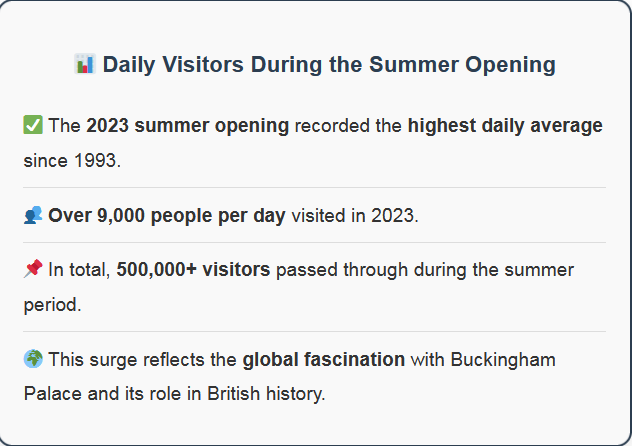
📊 Daily Visitors During the Summer Opening
- ✅ The 2023 summer opening recorded the highest daily average since 1993.
- 👥 Over 9,000 people per day visited in 2023.
- 📌 In total, 500,000+ visitors passed through during the summer period.
- 🌍 This surge reflects the global fascination with Buckingham Palace and its role in British history.
What Makes Buckingham Palace So Special?
To understand the debate, you first need to understand what Buckingham Palace really represents.
-
Location: Central London, a short walk from Westminster and St. James’s Park
-
Rooms: 775 in total, including 52 royal and guest bedrooms, 188 staff bedrooms, 92 offices, and 78 bathrooms
-
Size: Over 77,000 square meters (that’s bigger than 12 football fields combined)
-
Use: It’s the monarch’s official London residence, a workplace for the Royal Household, and the main stage for state events and ceremonies
Buckingham Palace is not just a house—it’s a working palace. Important visitors like presidents and prime ministers are welcomed there. National celebrations, such as royal weddings or the King’s official birthday parade, happen in front of its gates. And yes, it’s also where the royal family lives and works.
Right now, the palace is only open to the public for around 10 weeks each summer, when the monarch is away. During that time, visitors can explore the lavish State Rooms, art collections, and even some of the palace gardens. Tickets sell out quickly, proving there’s massive interest.
But the question remains: if demand is so high, why not open Buckingham Palace all year?
Why Does Buckingham Palace Need So Much Money?
Think about your own home for a moment. Maybe you’ve had to fix a leaky roof, replace a boiler, or repaint walls. Now multiply that by 775 rooms and add in chandeliers, priceless artwork, centuries-old furniture, and historic plumbing.
Keeping Buckingham Palace in good shape costs tens of millions of pounds every year. Some reports even put the long-term renovation bills at over £350 million.
Here’s where the money goes:
-
Heating and electricity: Imagine the bill for lighting chandeliers in hundreds of rooms!
-
Repairs and restoration: Old walls, ceilings, and pipes don’t fix themselves.
-
Security: Protecting the King, the royal family, and the building itself is a huge task.
-
Staff wages: Hundreds of employees—from cleaners to curators to gardeners—keep the palace running.
Without constant maintenance, parts of the palace could literally fall apart. In fact, reports have described leaking roofs, broken lifts, and outdated wiring as major issues.
So, who should pay for all this? Right now, a big part of the funding comes from taxpayers through the “Sovereign Grant,” which sparks regular debates. That’s why the idea of opening Buckingham Palace all year—to let tourism pay for it—sounds appealing.


The Case for Opening Buckingham Palace All Year
Let’s break down why supporters think this is a great idea.
1. A Self-Funding Palace
Instead of relying heavily on taxpayers, Buckingham Palace could generate its own income. Museums, castles, and heritage sites across the world already do this successfully. Why not the most famous palace in the world?
2. Tourism Goldmine
London already welcomes around 30 million visitors each year. Many of them would happily pay to step inside Buckingham Palace, no matter the season. An all-year schedule could bring in millions more in ticket sales.
3. Educational Value
Opening the palace more widely could turn it into one of the world’s most powerful teaching tools. Students, tourists, and historians could explore British history in the very place where so much of it happened.
4. Public Relations Win for the Monarchy
In modern times, people expect institutions to be more open and accessible. Allowing the public in all year would show that the royal family is sharing their heritage rather than keeping it hidden behind locked gates.
What Would Year-Round Access Look Like?
If Buckingham Palace were open all year, it wouldn’t mean throwing open every single room. After all, it’s still a private residence and a working office. Instead, we could imagine a system like this:
-
Rotating areas open to the public. For example, the State Rooms in summer, special exhibitions in winter, or different wings depending on royal use.
-
Seasonal themes. Imagine a Christmas at Buckingham Palace tour with festive decorations, or a spring tour highlighting royal gardens.
-
Cultural events. Concerts, lectures, and exhibitions could turn the palace into a year-round cultural hub.
-
Virtual access. For those who can’t travel, virtual tours could be offered, generating extra revenue.
This way, the King and his household could still live and work there, while the public enjoys wider access.
Challenges That Can’t Be Ignored
Now, before we get too carried away, there are real obstacles.
Privacy and Daily Life
The monarch still uses Buckingham Palace as a home and workplace. Constant crowds might disrupt official duties—or even make daily living uncomfortable.
Security Concerns
Opening doors year-round would mean thousands more visitors. Security risks would increase dramatically, requiring more staff, more checks, and more surveillance.
Preservation Risks
Think about how many shoes, cameras, and backpacks would pass through delicate carpets and historic rooms. Extra foot traffic could damage priceless artifacts unless carefully managed.
Costs of Opening
Ironically, keeping the palace open all year would also add costs—more staff, more cleaning, more heating, and more security. Supporters argue these would be outweighed by ticket sales, but it’s still a balancing act.
Visit UK Blogs on WhatTimeInUK.com
Lessons from Other Palaces
This idea isn’t without precedent. Around the world, many royal palaces are open to the public for most of the year.
-
Versailles (France): Once a royal residence, now one of the most visited museums in Europe.
-
The Vatican Museums (Italy): Home of the Pope, yet open almost daily to millions of visitors.
-
The Royal Palace of Madrid (Spain): Still used for state ceremonies but open most of the year to tourists.
These examples show that a balance between public access and royal use is possible. Buckingham Palace could adapt a similar model.
The Debate: Public Treasure or Private Home?
At the heart of this issue is a big question: Who does Buckingham Palace really belong to?
-
Supporters of opening it all year argue that the palace is part of national heritage, funded by the people, and should be accessible to them.
-
Critics argue that it is still the King’s official home and workplace, so expecting full access is unfair.
This tension reflects broader debates about the monarchy’s role in modern Britain. Should it remain a symbol of tradition, or should it evolve to meet public expectations of transparency and openness?
How Would This Impact the Royal Image?
It’s not just about money. The monarchy is also about symbolism. Opening Buckingham Palace year-round could:
-
Modernize the monarchy. It would show that the royals are adapting to modern times.
-
Strengthen public support. People might feel more connected to an institution that shares its treasures.
-
Generate goodwill internationally. Tourists from all over the world would experience royal culture firsthand.
On the other hand, some fear it could cheapen the palace, turning it into a “theme park” rather than a symbol of dignity. The balance would be crucial.
A Glimpse Into the Future
If you look closely, the palace already seems to be moving in this direction. In recent years, more rooms and exhibitions have been added to the public tours. Each time, the demand has been huge.
It’s not hard to imagine a future where Buckingham Palace becomes a living museum that blends royal tradition with public access. Technology, like timed ticketing and virtual tours, could make this transition smoother.
What Would Visitors Gain From Year-Round Access?
If Buckingham Palace opened fully, visitors could enjoy more than just a quick summer tour. Here’s what might be possible:
-
Seasonal tours: Spring gardens, Christmas decorations, royal anniversaries.
-
Behind-the-scenes looks: Exhibits on royal staff, kitchens, or how major events are planned.
-
Royal history galleries: Interactive exhibits tracing monarchs through time.
-
Special events: Music festivals, art displays, or lectures on history and culture.
This wouldn’t just be tourism. It would be education, culture, and national pride on display.
What Do People Really Think About Buckingham Palace’s Costs?
Whenever Buckingham Palace’s upkeep is mentioned in the news, public opinion usually splits into two camps.
-
“It’s worth every penny.”
Supporters argue the palace is priceless. It’s not just a royal home but a symbol of Britain, attracting millions of tourists every year. Without it, London wouldn’t be the same. -
“Why should taxpayers pay for it?”
Critics see the cost as unfair. With so many public services under strain, spending millions on gilded ceilings and royal ballrooms doesn’t sit right with everyone.
Here’s the catch: both sides have a point. Buckingham Palace brings in enormous tourism value, but it also drains resources. That’s why opening it all year could strike the right balance—it keeps the palace funded without asking taxpayers to foot the entire bill.
Could Buckingham Palace Become the World’s Top Tourist Attraction?
Let’s play with the numbers for a moment.
-
The Louvre in Paris attracts over 9 million visitors annually.
-
The Vatican Museums see around 6 million.
-
Even the Tower of London, just down the river, gets nearly 3 million a year.
Now imagine if Buckingham Palace was open 365 days a year. With London’s tourism power, it could easily become one of the top three most visited attractions in the world.
Think about the potential:
-
A steady stream of visitors from every continent
-
Jobs created in tourism, security, hospitality, and retail
-
Additional revenue flowing into hotels, restaurants, and transport
It wouldn’t just be the monarchy that benefits. The whole economy would get a healthy boost.
The Emotional Pull of Buckingham Palace
Money and numbers aside, there’s another reason why people want Buckingham Palace opened all year—it tugs at the heart.
For many, seeing the palace is a once-in-a-lifetime dream. They line up at the gates, take photos of the Changing of the Guard, and hope for a glimpse of royal life. But imagine if they could actually step inside the walls any time of the year.
-
For a child, it could be like walking into a fairy tale.
-
For history lovers, it’s a chance to connect directly with centuries of tradition.
-
For visitors from abroad, it’s the highlight of their London trip.
That emotional connection matters. It transforms a trip into a memory people cherish forever.
Balancing Tradition and Modern Expectations
The monarchy has always been about tradition. But in the modern world, tradition has to walk hand-in-hand with practicality.
Opening Buckingham Palace all year could:
-
Preserve history by funding maintenance through visitor income
-
Make the monarchy more relevant to younger generations who value openness
-
Allow people worldwide to feel more included in Britain’s story
Some argue that the royal family must protect its privacy at all costs. Others say they owe it to the public to share their heritage more widely. The truth probably lies somewhere in the middle: keep the palace a working home, but allow the people who fund it to experience more of it.
What Would Happen If Nothing Changes?
Here’s a scenario to think about: what if Buckingham Palace keeps its current 10-week summer opening?
-
Costs will continue to climb. Old buildings rarely get cheaper to repair.
-
Taxpayer funding will still be debated every year.
-
The monarchy may risk appearing “out of touch” in an age when transparency is expected.
On the flip side, year-round opening could solve many of these problems in one stroke. It may not be perfect, but it’s a forward-looking solution.
Conclusion: Should Buckingham Palace Be Open All Year?
So, where does this leave us? On one hand, Buckingham Palace is incredibly expensive to maintain, and year-round access could help it pay for itself while offering more to the public. On the other hand, privacy, security, and preservation remain serious challenges.
Maybe the answer lies in the middle: open more often, in more creative ways, while still protecting the palace’s role as a home and workplace.
What’s clear is this: Buckingham Palace is not just another building. It’s a living symbol of Britain’s past, present, and future. Whether or not the doors stay open all year, the debate reminds us that this palace isn’t just about bricks and gold—it’s about identity, tradition, and how a nation sees itself in the 21st century.